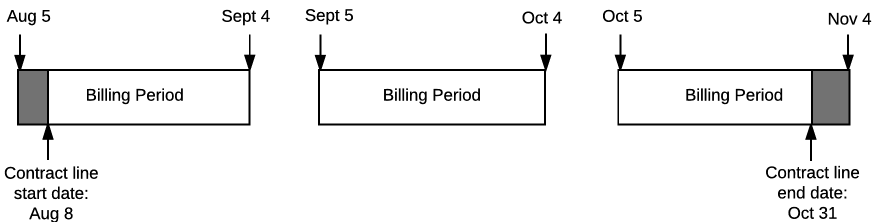
Essentially, a partial period is one where the start date of the contract line item does not fall on the first day of a billing period, or when the end date of the contract line item does not fall on the last day of a billing period. This means that the contract line item has only spanned part of the start or end period.
A more precise explanation of how partial periods are calculated is given below.
A first billing period is considered a partial period if the following calculation is true:
| (Contract line start date + Billing term) - Billing term ≠ Contract line start date |
In the example illustrated below, a contract line has a start date of Tuesday, August 8, 2017 with a billing term of MB+4d (so each billing period starts 4 days after the first day of the month).
Contract line start date (Tuesday, August 8, 2017) + billing term (MB+4d) = Tuesday, September 5, 2017.
Tuesday, September 5, 2017 - billing term (WB+4d) = Saturday, 5 August, 2017.
This is not the same as the contract line start date (Tuesday, August 8, 2017), which means that the first billing period is a partial period.
A final billing period is considered a partial period if the following calculation is true:
| Contract line end date + 1 day ≠ Billing period start date + Billing term |
In the example illustrated above, a contract line has an end date of Tuesday, October 31, 2017 and the billing term is MB+4d.
Final billing period start date (Thursday, October 5, 2017) + billing term (MB+4d) = Sunday, November 5, 2017.
This is not the same as the contract line end date + 1 day (Wednesday, November 1, 2017), which means that the final billing period is a partial period.
Related Concepts
Calculating Actual Day Proration
Calculating 30 Days per Month Proration
Calculating Whole Month Threshold Proration
Adjusting Final Period Value to Remainder from First Period
Custom Proration Calculation Methods
Related Tasks
Assigning a Proration Policy to a Contract
Assigning a Proration Policy to Multiple Contracts
Reference